
It might be really stressful when determining the amount of epoxy you need in a mixture or how to apply a coat of epoxy on a surface. It is even more difficult the first time, but the good news is our how much epoxy do I need for a table top article is here to help.
When you want to make an epoxy mixture, you need to have a good idea of the amount required for use, so you don’t end up having too of epoxy in the mix or have too little epoxy in the mix.
The truth is you are likely to get frustrated when using epoxy for the first time, so this is the right place if you want to know how much epoxy you need for a tabletop. Several factors help determine how much epoxy you need, but this article will discuss the most crucial factors.
There are few things about the surface you need to be aware of before you can finally be known how much epoxy will be required on the surface. These things are;
- Coating thickness
- Width
- Length
It will also help if you find out if you will be required to seal the coat or not and how edges will be treated so you can make a simple deduction. For example, when wanting to cover a tabletop, a gallon containing epoxy can cover about twelve square feet.
If you are working on a rectangular surface, you will calculate the exact epoxy you need. Then, all you have to do is follow these simple steps below.
How Much Epoxy Do I Need For A Table Top
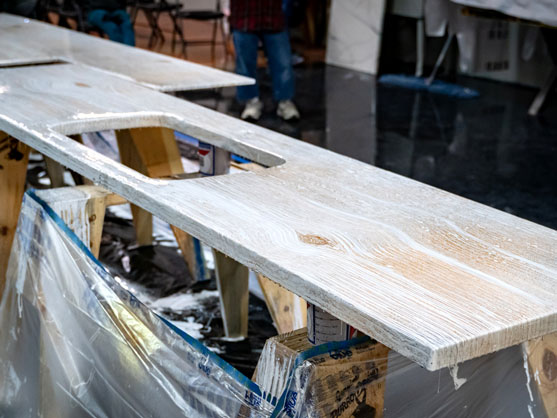
Listed below are some of the steps you are required to take;
- Get a measurement of the material that needs to be coated
- Find out how thick you want your epoxy to be
- Coating thickness, length, and width should be multiplied, while your thickness should be decimal.
- The result you have is for the tip of the table, and it is easier when you are working with a round object and not counter or bar objects.
- Get the diameter measurement.
- To get the radius, the diameter should be divided by 2
- Multiply square radius with Pi to get volume in cubic inches
- Divide the value obtained with 1.805, which converts cubic inches to US fluid ounces
- You can divide by 128 if you want to convert ounces to gallons
If the area of a given surface is known already, the following steps are required in calculating the volume required;
- Use the desired coating thickness to multiply the given area
- Fractions should be converted to decimals and feet to inches so the accurate volume can be obtained
- It would be best if you converted cubic inch volume to ounces
- By dividing with 128, you will convert ounces to gallons
After successfully calculating the amount of epoxy required, you will need more if you want the epoxy to run over the tabletop edges. It means you might end up losing a bit of the epoxy mixture to overflow or when mixing.
You should add five or ten percent of epoxy to make up for the one that might get wasted in the long run.
How Many Square Feet Does 1 Gallon Of Epoxy Cover
Almost every coating epoxy on the market is likely to cover about 12 square feet, and an epoxy gallon is made up of half-gallon hardener and half resin each. It might also vary from one brand to another, so the manufacturer’s instructions must be checked and followed.
It would be best to have extra epoxy at hand than what you need to work with because it is better to have more than a little epoxy quantity available. Running out of epoxy has a lot of disadvantages. If you run out of epoxy when working on a table, you can return and add epoxy when you wish to.
There will always be a visible line that will show where the first and second pour meets. This line will cost more money and time to wipe off, which explains why it is safer for you to have excess epoxy at hand than have very little.
Three factors will come into play to determine how many square feet a gallon of epoxy will cover. These are;
- Damming or self-leveling
- Seal coating
- Thickness
Now let us look at these factors extensively.
Seal Coating
So many people are left confused several times if a seal coat is needed, but seal coats are needed only when working on porous materials and wood. Seal coats make sure air bubbles do not come out through the substrate while applying the flood coat.
Seal coats are thin layers of epoxy that can be applied on porous or wood surfaces using a brush, and seal coats make sure air bubbles do not form on the formal epoxy layer.
You can add the thicker and final epoxy layer immediately after the sealing layer gets cured, and you don’t have to worry about air bubbles while you’re at it. A more budgeted initial mix will be needed when using a seal coat, and this also explains why it is safe for you to mix more than what is required.
Make sure epoxy for the final coat and seal are not mixed at the same time because you can only apply the final coat when the seal gets dried. Mixing all the epoxy at once will cause it to get cured while you are still in the bucket and while waiting for the seal coat to get cured.
Damming Or Leveling
You need to know if you want to allow epoxy flow over or to dam the edges when preparing an epoxy mix, and you can either allow the epoxy flow over the surface normal or control the thickness of the coat.
You will have total control over the final layer’s thickness if you dam the surface edges, but removing the material used in damming the edges might be a little bit difficult later. When using a self-leveling method, epoxy is going to self-level at a thickness of 1/8 per inch.
Self-leveling epoxy is most sold for home use, but it also has the potential of creating a big mess. It is why covering everything coated in epoxy in your home with plastic sheets is necessary. Letting the epoxy level itself through damming will give you an idea of how much epoxy you will need.
For two equal-sized surfaces, less epoxy will be required to obtain coats of the same thickness. However, letting it flow over edges will require the use of more epoxy.
Thickness
Got an idea how thick you want your epoxy to be? Several epoxies on the market are formulated to self-level so they can create a 1/8 inch thick coat. Of course, you will need more epoxy to create a thick epoxy, but you will need less if you intend to create a thinner epoxy.
It is easy to create thicker epoxies than get a thinner one while keeping it level. You will need a mold or dam that holds in everything when trying to make a coat thicker, and this also means you do not require the use of as much epoxy as assumed in creating a thicker layer.
One crucial point you should note is not using casting resin in place of epoxy. It is because casting resin has a thinner nature than epoxy, meaning they spread more than epoxy. Therefore, you can use a small amount of casting resin to cover a large surface.
On the other hand, casting resin does not make good coats, so they are good for encasing and not protecting. Unfortunately, this means they do not offer the same level of durability you will get when you use epoxy. Here are some of the tips you should pay attention to when working with epoxy.
Guiding Tips When Working With Epoxy
- Several epoxy coating can cover a 12 square feet area
- It would help if you did not mix epoxy for seal and final coating at the same time when seal coating
- All areas epoxy will not work on should be covered using plastic sheets when self-leveling
- It would help if you had more epoxy at hand than what is required to work with
- You should obtain the width and length of the surface to be coated to get the right measurement
Conclusion – How Much Epoxy Do I Need For A Table Top
The shape of the object coated will determine the measurement of epoxy required, which also covers the thickness. Having a gallon of epoxy that will cover a 12 square feet area is a good place to start, but ensure you pay close attention to every instruction provided by the manufacturer when working with epoxy.
Finally, it would be best if you had more epoxy at hand than what you need, or you risk not doing a good job.
New post: 4 Eye-Opening Ways To Speed Up Polyurethane Drying Time